

As the stock prices tumble with every big fall in the broader Index, investors, especially the retail investors wonder if they should buy more to average out their cost or book losses fearing more correction going forward or just stay invested with what they have and wait for the stock prices to rebound.
Well, no one knows at what levels the markets or a particular stock will bottom out and hence timing the markets is out of question. However, there are many underlying factors that affect the stock market and studying those factors may help us in determining the direction which the broader markets may take going forward. In the following paragraphs we would study some of these factors and try to analyse their current position and future direction.
Economic growth: Higher economic growth levels have a positive correlation with the markets as higher growth signals more demand for goods and services thereby boosting corporate earnings and share prices.
However, India’s gross domestic product (GDP) growth rate has slowed to a six-year low of 5% in the first quarter of FY 2019-20. While manufacturing sector grew at 0.6% as against 12.1% in the same quarter of the previous year, agriculture sector growth rate fell to 2% from 5.1%. The real estate sector grew at 5.7% in the first quarter of this financial year, compared with 9.6% in the same quarter of the previous year.
Considering the production cuts in the auto sector and job losses in various sectors it seems highly unlikely that the GDP numbers would be any better in the second quarter.
Rate of Interest: Lower interest rates again have a positive correlation with earnings as a lower borrowing cost improves profit margins and earnings per share, leading to a rise in share price. Borrowing cost in India has been high which eats into the margins of the industry players. Further, transition of a rate cut also takes time and many a times does not happen. The latest decision of RBI making it mandatory for banks to link loans for housing, autos, MSEs to external benchmark may make the transition faster. However, the impact this move will have, especially when Repo rate is already below 6% is anybody’s guess.
Socio-economic and Political Stability: Stock markets dislike shocks that could threaten economic stability and future growth. Thus, they get impacted by political events, terrorist attacks, sanctions on oil producing nations, trade wars etc. Though the election result was a big positive for the Indian market, however, issues like escalating tensions between India and Pakistan, trade war between US and China, Brexit effect etc do pose a threat to the economic stability and growth prospects in a developing economy like India.
Investor Confidence and Return Expectations. Investor confidence and return expectations play a vital role in determining the market direction. Our market movement is very much dependent on the inflow and outflow of foreign funds. As the foreign investors are always on the lookout for value creation and profit maximization, any indication of a lower return may make them sell off from the Indian market and park their money outside where return prospects are higher. Data suggests that the imposition of an additional surcharge on the super rich, resulted in withdrawal of more than Rs 30,000 crore from the Indian equity market by FPIs between July and August. However, the government’s decision to remove additional surcharge has improved foreign investor sentiment. Experts suggest that if the government relaxes its norms for long-term capital gain (LTCG) tax which was introduced last year it would further improve the investor sentiment and bring back the funds that have gone outside.
Bandwagon effect. Many a times the stock markets seem to over-react to certain events which may not directly impact the cash flows or earning potential of the corporate. The huge fall in the Indian stock markets in 2008-09 on account of the global crisis when the Indian fundamentals were still strong is one such example. There are many such examples worldwide wherein investors jumped the bandwagon both at times of a bull run and a bear run. It’s just the sentiments that make the markets rise or fall the extra bit due to the over enthusiasm of the investors. However, for a prudent investor it is the right time for booking profits/value hunting by either selling or buying during such bull or bear runs respectively.
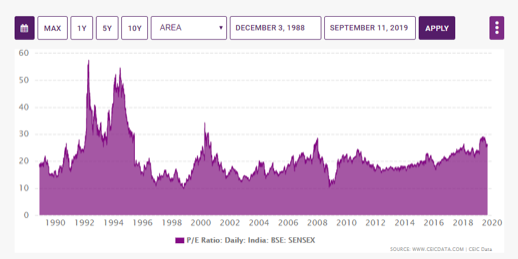
Price/Earning (P/E) ratios: Fundamentally, PE ratio is one of the best guides for selecting any stock. As the markets generally discount future cash flows, hence, share prices reflect the future earning potential of the corporate. If share prices/index rise significantly above historical averages without any rise in future earning potential/growth prospects, it may be termed as an overvalued stock/index which is due for correction at some point in the near future. Presently, as on September 2019 the Sensex is recording a daily PE ratio of 26.20. The ratio reached an all time high of 57.42 in April 1992 and a record low of 9.83 in November 1998. The PE chart shown below signals a downward movement from the present 26.20 levels towards the long term average of say 20 odd levels.
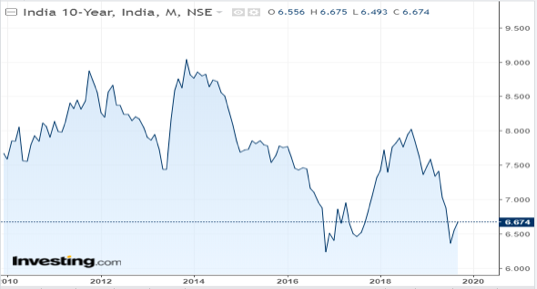
Bond Yields: Equity markets also have a correlation with other markets like money market, commodity market, currency market etc. However, with respect to the Indian market the correlation between equity market and bond market has become more pronounced. Bond yields are an important determinant of equity valuations as these are used as risk free rates while calculating cost of capital and any increase in the risk free rate increases the cost of capital for equity thereby escalating the discounting rates and diminishing the stock valuation. The consensus is that equity markets have a negative correlation with bond yields. As the RBI cuts its benchmark rate the yields have started moving northwards which is evident by the sharp spike in the yield curve (see the chart below), thereby making the bond markets more attractive for investors.
Conclusion:
Though there are many other factors which may guide the movement in the stock market, however, on analysing the above key factors it appears that on the domestic front issues such as dismal growth numbers, production cuts, higher unemployment rates, lower consumption, crowding out of private investment, liquidity issues in the NBFC sector, flight of foreign capital etc will play out heavily on the investor sentiment. Global factors like the fear of a recession triggered by US China trade war, Brexit effect etc may further dampen the mood.
We suggest that investors, especially the retail investors should be cautious before allocating large sums at one go into equity markets until investor confidence gets restored. For those who want to invest, part by part investment in select blue chip stocks with an attractive P/E ratio, low debt gearing and a high credit rating may be a good option, while for those who do not understand the market movements it’s always better to invest in mutual funds, preferably an SIP.
Happy Investing !!